
AI is the interface. QP is the structure underneath.
The goal is not one impressive generation. It is a website that remains easy to understand and change.
From what you know to something built to last
Start with discovery
Goals, audiences, evidence, constraints, identity, and unanswered questions form the starting context—not a generic template.
Compose with a vocabulary
Pages use defined sections, regions, content elements, components, themes, and metadata instead of relying on free-form implementation.
Keep changing normally
New pages, updated events, clearer services, and fresh photography do not require the whole website to be rediscovered.
The working sequence: Research → Site Discovery → content inventory and information architecture → sitemap and page decisions → imagery strategy → visual and theme direction → author site and pages → select or create theme → validate → build → review the rendered result against Discovery.
That final review closes the loop. If the rendered site misses the organization, audience, identity, content, or visual intent, QP returns to the decision that owns the miss instead of covering it with another one-off patch.
AI can reason freely. The website does not have to.
Reason where reasoning helps
AI is good at the messy part: understanding goals, exploring possibilities, writing, organizing, composing, and deciding how to approach a problem. QP does not try to make that process deterministic.
Traditional software already works this way with people. Users can make unpredictable choices, but the interface gives them a defined way to interact with the system. An AI agent can choose its own path through QP in much the same way.
The intelligence can be flexible because the system underneath does not have to be.
Turn reasoning into something deterministic
AI expresses its decisions as structured JSON using QP's known vocabulary. That document can be validated before it becomes a website, so mistakes can be caught and corrected while the agent is still working.
Once valid, QP takes over. Deterministic renderers turn the same structure into semantic HTML the same way every time. AI decides what to build; QP defines what a valid QP website is.
That structured document remains the source of truth after launch. AI can keep editing it directly, and a future human-friendly editor can work with the same content more like a document than a codebase.
Reason where uncertainty is useful. Use deterministic software where certainty matters.
Born to run
- Semantic, valid HTML and responsive layouts
- Accessible interaction and presentation patterns
- Consistent themes that resist visual drift
- Performance-conscious assets and output
- Search, social, and answer-engine metadata
- Canonical URLs and generated sitemaps
- Security-minded deployment defaults
- Repeatable builds and deployable static output
Built with QP
And this isn't theoretical.
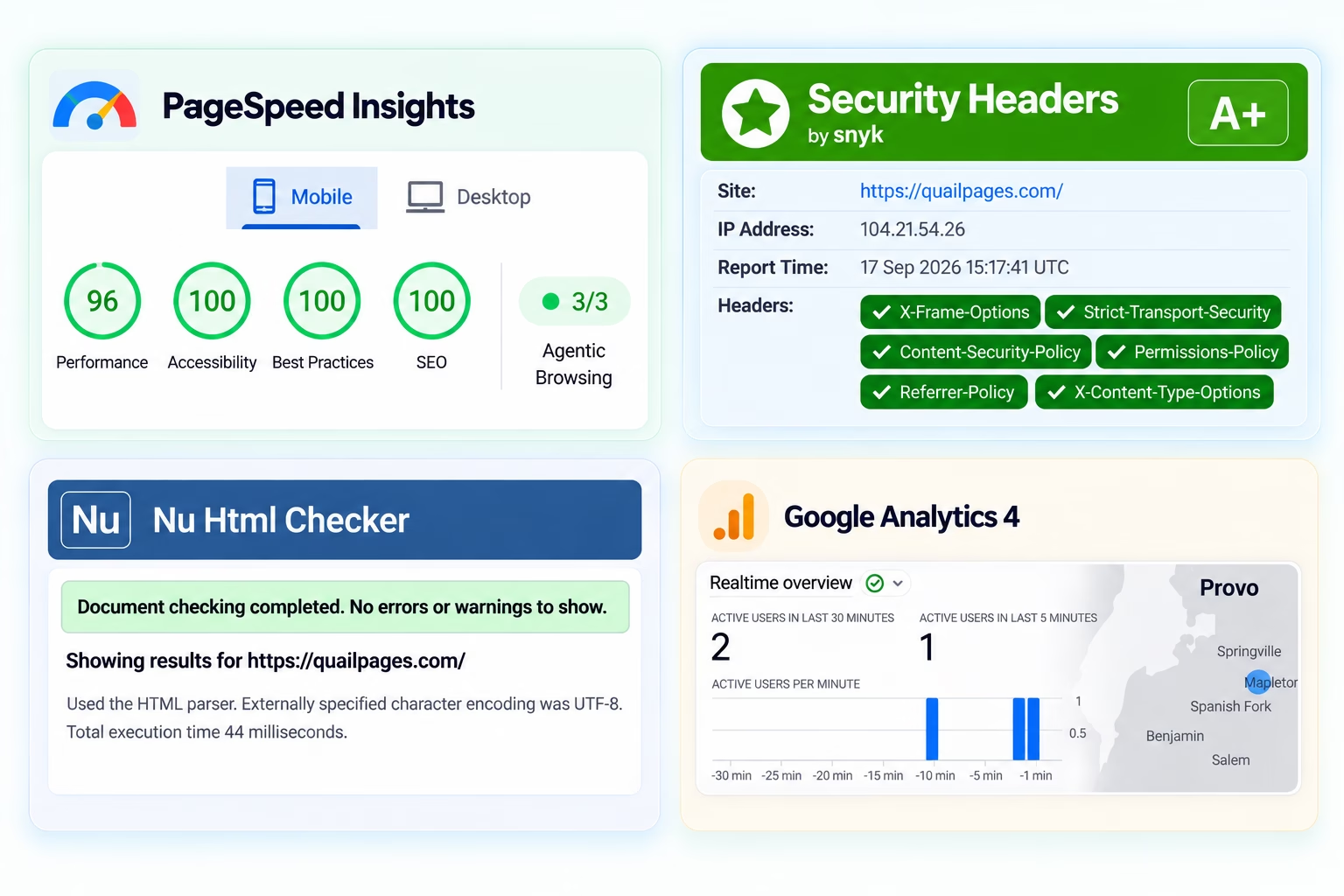
QuailPages.com is itself built with QP. Independent tools can inspect the output just like any other public website.
Check the results yourself: PageSpeed Insights · Security Headers · W3C HTML Checker
The website can improve without being rewritten
Search practices evolve. Security guidance changes. New devices, protocols, agents, and expectations appear. A traditional site often carries the implementation decisions that were current when it was built until somebody comes back and modernizes them.
QP separates the authored website from the machinery that renders it. The goal is for improvements to the renderer and platform to flow into sites wherever possible without asking AI to crawl through and reconstruct their content, design, or intent.
A website system with boundaries
QP is designed for a large class of substantial, content-driven websites. Custom databases, full ecommerce platforms, CRMs, and specialized software products have different jobs and deserve different foundations.